



August 22, 2025 at 5:56 PM

SpaceX’s ninth test flight of Starship launches into space, ends in a spin

SpaceX's ninth test flight of Starship launches into space, ends in a spin | TechCrunch
SpaceX's Starship successfully separated from its Super Heavy rocket booster and reached orbit Tuesday evening, but later began spinning and made an
techcrunch.com
May 28, 2025 at 1:01 AM
SpaceX’s ninth test flight of Starship launches into space, ends in a spin

Several kerbels have died but we managed to achieve orbit…then had to spin frantically to fall out of orbit and return to earth.
I greatly look forward to more of this one
I greatly look forward to more of this one
I may not be up for social endeavors tonight but I am up to blow up as I, first the first time, try out the Kerbal Space Program and boldly go where no..uh...green thing has gone before at 5 PM Eastern time at twitch.tv/boozybadger
May 7, 2026 at 10:59 PM
Several kerbels have died but we managed to achieve orbit…then had to spin frantically to fall out of orbit and return to earth.
I greatly look forward to more of this one
I greatly look forward to more of this one

More planets and moons should have a 3:2 spin-to-orbit ratio like Mercury.
June 14, 2025 at 8:55 AM
More planets and moons should have a 3:2 spin-to-orbit ratio like Mercury.

more alien yuri comic 💜💚


July 20, 2026 at 12:39 AM
more alien yuri comic 💜💚

Nature research paper: Superconductivity and spin canting in spin–orbit-coupled trilayer graphene
https://go.nature.com/4m3BSL0
https://go.nature.com/4m3BSL0

Superconductivity and spin canting in spin–orbit-coupled trilayer graphene - Nature
Introducing spin–orbit coupling by substrate proximity effect leads to an enhancement of superconducting phases in rhombohedral trilayer graphene.
go.nature.com
May 8, 2025 at 12:47 PM
Nature research paper: Superconductivity and spin canting in spin–orbit-coupled trilayer graphene
https://go.nature.com/4m3BSL0
https://go.nature.com/4m3BSL0

SPACE FACTS: DAY 97/365🛰️🧪🔭
Mercury is not tidally locked to the Sun, but it is in a spin-orbit resonance with the Sun. In a tidally locked orbit, the spin period and orbit are the same, 1:1. But for Mercury, that ratio is at 3:2. That is, Mercury rotates exactly three times every two orbits.
Mercury is not tidally locked to the Sun, but it is in a spin-orbit resonance with the Sun. In a tidally locked orbit, the spin period and orbit are the same, 1:1. But for Mercury, that ratio is at 3:2. That is, Mercury rotates exactly three times every two orbits.
September 19, 2023 at 3:06 AM
SPACE FACTS: DAY 97/365🛰️🧪🔭
Mercury is not tidally locked to the Sun, but it is in a spin-orbit resonance with the Sun. In a tidally locked orbit, the spin period and orbit are the same, 1:1. But for Mercury, that ratio is at 3:2. That is, Mercury rotates exactly three times every two orbits.
Mercury is not tidally locked to the Sun, but it is in a spin-orbit resonance with the Sun. In a tidally locked orbit, the spin period and orbit are the same, 1:1. But for Mercury, that ratio is at 3:2. That is, Mercury rotates exactly three times every two orbits.

GEN Z: what if we move the earth slightly further from the sun, to combat global warming
BOOMERS: but if we get it wrong we’ll spin out of orbit, killing us all
MILLENNIALS: I’m not hearing a downside
BOOMERS: but if we get it wrong we’ll spin out of orbit, killing us all
MILLENNIALS: I’m not hearing a downside
December 21, 2023 at 12:47 PM
GEN Z: what if we move the earth slightly further from the sun, to combat global warming
BOOMERS: but if we get it wrong we’ll spin out of orbit, killing us all
MILLENNIALS: I’m not hearing a downside
BOOMERS: but if we get it wrong we’ll spin out of orbit, killing us all
MILLENNIALS: I’m not hearing a downside

New NASA-funded research reveals how a planet’s tilt, spin, and orbit shape land-based habitability. Fast spins and stable tilts help maintain temperatures fit for life—far beyond just sitting in the Goldilocks zone.
Credit: ESA, NASA, and L. Calçada (ESO for STScI)
Credit: ESA, NASA, and L. Calçada (ESO for STScI)

June 25, 2025 at 4:35 PM
New NASA-funded research reveals how a planet’s tilt, spin, and orbit shape land-based habitability. Fast spins and stable tilts help maintain temperatures fit for life—far beyond just sitting in the Goldilocks zone.
Credit: ESA, NASA, and L. Calçada (ESO for STScI)
Credit: ESA, NASA, and L. Calçada (ESO for STScI)

We are pleased to announce our discovery of #GW241011 and #GW241110
Both come from binary black holes where one black hole is much larger than the other. The larger black holes have large spin. Could these black holes have formed in a previous merger?
ligo.org/science-summ...
#O4IsHere 🔭🧪⚛️☄️
Both come from binary black holes where one black hole is much larger than the other. The larger black holes have large spin. Could these black holes have formed in a previous merger?
ligo.org/science-summ...
#O4IsHere 🔭🧪⚛️☄️

October 29, 2025 at 1:58 PM
We are pleased to announce our discovery of #GW241011 and #GW241110
Both come from binary black holes where one black hole is much larger than the other. The larger black holes have large spin. Could these black holes have formed in a previous merger?
ligo.org/science-summ...
#O4IsHere 🔭🧪⚛️☄️
Both come from binary black holes where one black hole is much larger than the other. The larger black holes have large spin. Could these black holes have formed in a previous merger?
ligo.org/science-summ...
#O4IsHere 🔭🧪⚛️☄️

Zelenskyy should get the Nobel Peace Prize . . . now wouldn't that just spin you know who into orbit? 😂
December 28, 2025 at 8:34 PM
Zelenskyy should get the Nobel Peace Prize . . . now wouldn't that just spin you know who into orbit? 😂

The pair spin–orbit interaction (PSOI) between two electrons was long thought too puny to influence solids' electronic properties. Now researchers have proposed that in certain materials, PSOI is strong enough to engender unconventional superconductivity.

Spin–Orbit-Coupled Electrons May Form Superconducting Pairs
A previously neglected spin–orbit-coupling effect could be strong enough to engender unconventional superconductivity in certain materials.
physics.aps.org
January 2, 2025 at 7:25 PM
The pair spin–orbit interaction (PSOI) between two electrons was long thought too puny to influence solids' electronic properties. Now researchers have proposed that in certain materials, PSOI is strong enough to engender unconventional superconductivity.

Space junk isn't all the same. Here I look at an uncommon type of mission-related debris, the yo-yo de-spin weight.
#SpaceJunk #SpaceHeritage 🧪 🔭 🏺
#SpaceJunk #SpaceHeritage 🧪 🔭 🏺

A space junk bestiary: yo-yo de-spin weights
Among the oldest pieces of space junk in Earth orbit are de-spin weights from the US series of TIROS weather and TV satellites. I've been no...
zoharesque.blogspot.com
March 23, 2026 at 9:50 PM
Space junk isn't all the same. Here I look at an uncommon type of mission-related debris, the yo-yo de-spin weight.
#SpaceJunk #SpaceHeritage 🧪 🔭 🏺
#SpaceJunk #SpaceHeritage 🧪 🔭 🏺

we have the technology

October 21, 2025 at 8:35 PM
we have the technology
SPACE FACTS: DAY 192/365🧪🔭🛰️
Neptune's largest moon, Triton, orbits backwards! It is the only large moon in the solar system to have a retrograde orbit (opposite direction to Neptune's spin). This odd orbit points to a likely origin for Triton as a captured former dwarf planet from the Kuiper belt.
Neptune's largest moon, Triton, orbits backwards! It is the only large moon in the solar system to have a retrograde orbit (opposite direction to Neptune's spin). This odd orbit points to a likely origin for Triton as a captured former dwarf planet from the Kuiper belt.
January 21, 2024 at 5:20 AM
SPACE FACTS: DAY 192/365🧪🔭🛰️
Neptune's largest moon, Triton, orbits backwards! It is the only large moon in the solar system to have a retrograde orbit (opposite direction to Neptune's spin). This odd orbit points to a likely origin for Triton as a captured former dwarf planet from the Kuiper belt.
Neptune's largest moon, Triton, orbits backwards! It is the only large moon in the solar system to have a retrograde orbit (opposite direction to Neptune's spin). This odd orbit points to a likely origin for Triton as a captured former dwarf planet from the Kuiper belt.

RCP3: Motion Path Orbit
- Create a sequence
- Select a root entity for the sequence
- Create a track and select track entity
- Add motion path and change shape to Orbit
We can adjust nodes, path axis, and even enable entity spin during the orbit.
- Create a sequence
- Select a root entity for the sequence
- Create a track and select track entity
- Add motion path and change shape to Orbit
We can adjust nodes, path axis, and even enable entity spin during the orbit.
September 27, 2026 at 9:29 AM
RCP3: Motion Path Orbit
- Create a sequence
- Select a root entity for the sequence
- Create a track and select track entity
- Add motion path and change shape to Orbit
We can adjust nodes, path axis, and even enable entity spin during the orbit.
- Create a sequence
- Select a root entity for the sequence
- Create a track and select track entity
- Add motion path and change shape to Orbit
We can adjust nodes, path axis, and even enable entity spin during the orbit.

i'm very serious though, that a lot of people who are anti-ai suddenly don't care when it's sexual art or porn.
stop thinking w/ your dick or else i'll grab you by it and spin you so fast that i throw you into orbit so you can never use the internet again
stop thinking w/ your dick or else i'll grab you by it and spin you so fast that i throw you into orbit so you can never use the internet again
July 15, 2026 at 5:53 PM
i'm very serious though, that a lot of people who are anti-ai suddenly don't care when it's sexual art or porn.
stop thinking w/ your dick or else i'll grab you by it and spin you so fast that i throw you into orbit so you can never use the internet again
stop thinking w/ your dick or else i'll grab you by it and spin you so fast that i throw you into orbit so you can never use the internet again
Nature research paper: Twist-programmable superconductivity in spin–orbit-coupled bilayer graphene
https://go.nature.com/4m3F9Ki
https://go.nature.com/4m3F9Ki

Twist-programmable superconductivity in spin–orbit-coupled bilayer graphene - Nature
The superconductivity in Bernal bilayer graphene that emerges from the spin–orbit coupling induced by proximal tungsten diselenide can be tuned by modulating the twist angle between the two materials.
go.nature.com
May 12, 2025 at 2:35 PM
Nature research paper: Twist-programmable superconductivity in spin–orbit-coupled bilayer graphene
https://go.nature.com/4m3F9Ki
https://go.nature.com/4m3F9Ki

Both Elon and Starship spin out of control. When another Space-X Starship rocket spun out of control and failed to reach orbit yesterday Musk called the failure a “great success”. Musk’s “great success” is costing taxpayers. He gets $1 billion in the Trump budget for failing at Space-X #ProudBlue

May 28, 2025 at 5:25 PM
Both Elon and Starship spin out of control. When another Space-X Starship rocket spun out of control and failed to reach orbit yesterday Musk called the failure a “great success”. Musk’s “great success” is costing taxpayers. He gets $1 billion in the Trump budget for failing at Space-X #ProudBlue

A better idea than a space elevator: Simply spin a planet up to near orbital velocity and when the topsoil and ocean pile up into a ring system that touches the surface, simply walk into orbit and then jump off.
January 25, 2026 at 12:02 PM
A better idea than a space elevator: Simply spin a planet up to near orbital velocity and when the topsoil and ocean pile up into a ring system that touches the surface, simply walk into orbit and then jump off.

Launched in 2013 to study Mars' atmosphere from orbit, Maven mysteriously fell silent in early December after passing behind the red planet. Data indicated the spacecraft went into a fast spin, which disrupted its orbit and drained the onboard batteries. https://to.pbs.org/4fsgX3v

NASA declares its Mars Maven spacecraft dead after 6 months of silence
The space agency confirmed Wednesday that the mission had ended after more than a decade of observations.
to.pbs.org
June 5, 2026 at 11:37 AM
Launched in 2013 to study Mars' atmosphere from orbit, Maven mysteriously fell silent in early December after passing behind the red planet. Data indicated the spacecraft went into a fast spin, which disrupted its orbit and drained the onboard batteries. https://to.pbs.org/4fsgX3v

Winter Solstice
Shortest day
longest night
darkness curtain
at its Southern limit
earth, trees, plants
rest, decay, die
blue-green planet
spin now your orbit
towards the light once more
so we will experience
new life, eternal hope
#ImageAndVerse #Poetry #WinterSolstice #ECK #SouthernHemisphere
Shortest day
longest night
darkness curtain
at its Southern limit
earth, trees, plants
rest, decay, die
blue-green planet
spin now your orbit
towards the light once more
so we will experience
new life, eternal hope
#ImageAndVerse #Poetry #WinterSolstice #ECK #SouthernHemisphere

June 21, 2026 at 7:24 AM
Winter Solstice
Shortest day
longest night
darkness curtain
at its Southern limit
earth, trees, plants
rest, decay, die
blue-green planet
spin now your orbit
towards the light once more
so we will experience
new life, eternal hope
#ImageAndVerse #Poetry #WinterSolstice #ECK #SouthernHemisphere
Shortest day
longest night
darkness curtain
at its Southern limit
earth, trees, plants
rest, decay, die
blue-green planet
spin now your orbit
towards the light once more
so we will experience
new life, eternal hope
#ImageAndVerse #Poetry #WinterSolstice #ECK #SouthernHemisphere

Anyway, happy birthday to Jocelyn Bell Burnell, whose discovery transformed astronomy and astrophysics. 🧪 👩🔬 🔭
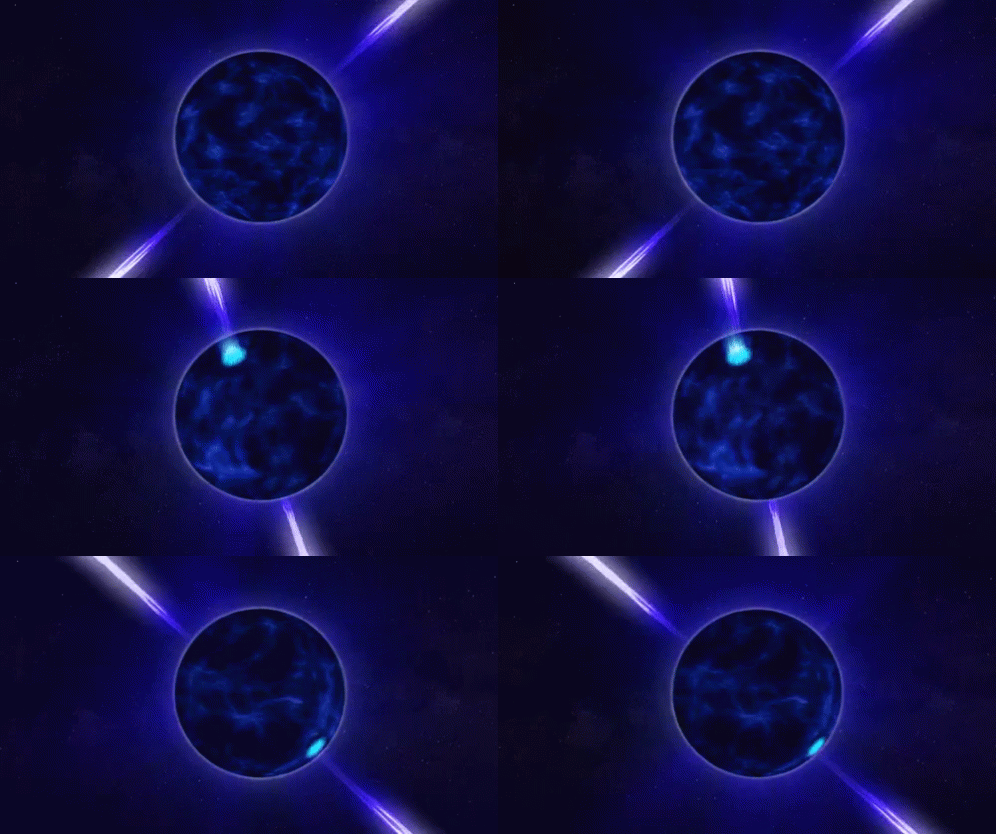
Nasa Nasa Gifs GIF
Alt: Animated gif of a spinner pulsar. It shows how intense radio beams emitted from spots near the poles spin with the orbit of the pulsar and sweep out circles in the sky with a regular period.
media.tenor.com
July 15, 2024 at 3:23 PM
Anyway, happy birthday to Jocelyn Bell Burnell, whose discovery transformed astronomy and astrophysics. 🧪 👩🔬 🔭

We are officially in the orbit of Epic Universe. 🚀✨
I’ve been obsessed with the colors of Celestial Park, so I had to put my own spin on the Chronos gates.
#UniversalEpicUniverse #fanart
I’ve been obsessed with the colors of Celestial Park, so I had to put my own spin on the Chronos gates.
#UniversalEpicUniverse #fanart

May 15, 2026 at 11:58 AM
We are officially in the orbit of Epic Universe. 🚀✨
I’ve been obsessed with the colors of Celestial Park, so I had to put my own spin on the Chronos gates.
#UniversalEpicUniverse #fanart
I’ve been obsessed with the colors of Celestial Park, so I had to put my own spin on the Chronos gates.
#UniversalEpicUniverse #fanart
SPACE FACTS: DAY 106/365 🔭🧪🛰️
There are over 6700 active satellites in orbit above us! These are in three main types of orbits: LEO (low Earth), MEO (medium Earth), and GEO (geostationary). LEO is by *far* the most common and takes ~1.5 hours to orbit the Earth.
Image: ESA/L. Boldt-Christmas
There are over 6700 active satellites in orbit above us! These are in three main types of orbits: LEO (low Earth), MEO (medium Earth), and GEO (geostationary). LEO is by *far* the most common and takes ~1.5 hours to orbit the Earth.
Image: ESA/L. Boldt-Christmas

September 28, 2023 at 4:05 AM
SPACE FACTS: DAY 106/365 🔭🧪🛰️
There are over 6700 active satellites in orbit above us! These are in three main types of orbits: LEO (low Earth), MEO (medium Earth), and GEO (geostationary). LEO is by *far* the most common and takes ~1.5 hours to orbit the Earth.
Image: ESA/L. Boldt-Christmas
There are over 6700 active satellites in orbit above us! These are in three main types of orbits: LEO (low Earth), MEO (medium Earth), and GEO (geostationary). LEO is by *far* the most common and takes ~1.5 hours to orbit the Earth.
Image: ESA/L. Boldt-Christmas